
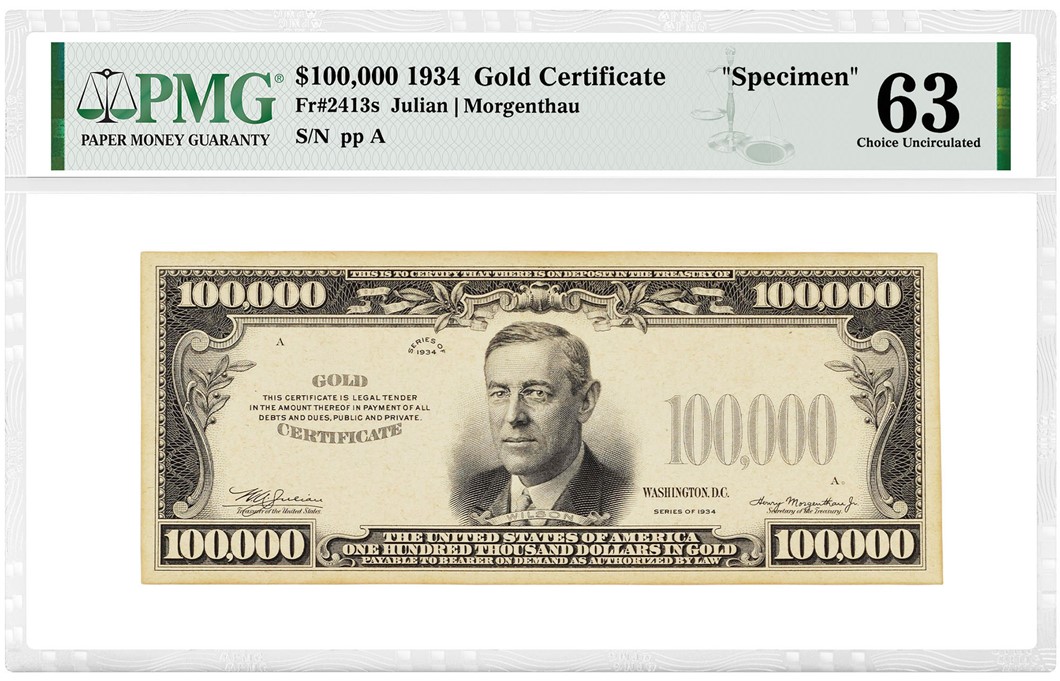
The Pinnacle of Numismatic Rarity: Arizona Coin & Bullion’s Acquisition of the 1934 $100,000 Gold Certificate.
In a landmark moment for numismatic history, August 2025, Arizona Coin & Bullion (“ACB”) has proudly acquired the only 1934 $100,000 Gold Certificate Uniface Front Specimen known to be in private hands, bringing this extraordinary piece back to its collector base in Arizona. Graded PMG Choice Uncirculated 63, this note represents the pinnacle of U.S. paper money, blending unparalleled rarity, historical significance, and breathtaking craftsmanship. As Arizona Coin & Bullion celebrates this acquisition, we invite collectors and enthusiasts to explore the story of this iconic note and its return to the Grand Canyon State.
A Singular Treasure: The Rarest U.S. Note in Private Hands
The 1934 $100,000 Gold Certificate holds the distinction of being the highest denomination of U.S. paper money ever produced. Created exclusively for interbank transfers between Federal Reserve Banks, these notes were never intended for public circulation. Of the 42,000 notes printed from December 18, 1934, to January 9, 1935, most were destroyed after use, with surviving issued notes—featuring their distinctive bright orange backs—held by institutions like the Smithsonian, the Bureau of Engraving and Printing, and Federal Reserve Banks in Richmond and San Francisco.


What makes Arizona Coin & Bullion’s acquisition truly exceptional is that this Uniface Front Specimen, pedigreed to the Taylor Family Collection, is the only known example available to private collectors. Unlike issued notes, this specimen features a blank back with “SPECIMEN NOT NEGOTIABLE” printed in silver, marking it as a unique artifact from an era when the U.S. was transitioning away from the gold standard. Its PMG 63 grade reflects excellent preservation, with subtle toning that enhances its allure.
Historical Significance: A Window into the Great Depression
Issued during the Great Depression under the Gold Reserve Act of 1933, the $100,000 Gold Certificate was a critical tool for settling large transactions between Federal Reserve Banks. Featuring a portrait of President Woodrow Wilson, engraved by G.F.C. Smillie, and the signatures of Treasurer William A. Julian and Treasury Secretary Henry Morgenthau Jr., the note bears the inscription: “This is to certify that there is on deposit in the Treasury of the United States of America one hundred thousand dollars in gold payable to bearer on demand as authorized by law.” This phrase, amended with “as authorized by law,” reflects the restricted redemption policies of the time, as the U.S. moved off the gold standard.

The note’s historical context adds to its mystique. Used briefly from 1934 to 1935, these certificates facilitated massive financial transfers during a pivotal economic period. Their destruction by the government ensured that only a handful of specimens and institutional examples survived, making Arizona Coin & Bullion’s note a singular opportunity for collectors.
Arizona Coin & Bullion’s Historic Acquisition
Arizona Coin & Bullion, a trusted name in precious metals and numismatics, serves Arizona’s collector community with a commitment to integrity and excellence. The acquisition of the 1934 $100,000 Gold Certificate marks a milestone for the company, reinforcing its dedication to bringing world-class rarities to its Arizona-based clientele. By securing this note, Arizona Coin & Bullion has not only added a crown jewel to its inventory but also brought a piece of numismatic history back to the state, where it can be appreciated by local collectors and enthusiasts. The note’s journey to Arizona Coin & Bullion is a testament to the company’s expertise in sourcing ultra-rare collectibles. Previously sold at a Heritage Auctions sale in February 2005 for $74,750, this specimen has since been touted as the sole example available to collectors. Its return to Arizona underscores ACB’s role as a steward of numismatic heritage, offering collectors a chance to engage with a piece of history that is unlikely to appear on the market again.
The Million Dollar Question: What’s the Estimated Value of the Note?
To provide a deeper analysis of the estimated value of the 1934 $100,000 Gold Certificate Uniface Front Specimen, graded PMG Choice Uncirculated 63, we incorporate the context of recent sales of 1934 $10,000 Federal Reserve Notes (FRNs), particularly the May 2025 sale of a Boston $10,000 FRN graded PMG 64 for $372,000, and the fact that approximately 350 such $10,000 notes are known to exist.
- Past Sale: In February 2005, this note sold at Heritage Auctions for $74,750, including the buyer’s premium, when it was one of three known in private hands. Its status as the sole privately held example today increases its scarcity.
- Recent Fractional Sale: In 2025, Kagin’s Digital sold 500 fractional shares of this note as an NFT, with shares priced at $1,000–$1,250 each, implying a total share valuation of ~$625,000, and a subsequent sale exit price at $650,000 bringing all shareholders to a profit. This figure reflects a premium for fractional ownership and blockchain-related costs, not necessarily the note’s standalone auction value.
Impact of Recent $10,000 FRN Sales
The sale of a 1934 $10,000 Federal Reserve Note (Boston) graded PMG 64 Choice Uncirculated EPQ for $372,000 in May 2025 provides a critical benchmark for assessing the $100,000 note’s value. Additional sales of $10,000 FRNs offer further context:
- September 2023: A 1934 $10,000 FRN (Boston) graded PMG 64 EPQ sold for $480,000, noted as tied for the highest-graded among 18 PMG-graded examples.
- May 2024: Another 1934 $10,000 FRN (Boston) graded PMG 65 Gem Uncirculated EPQ sold for $432,000.
- September 2020: A 1934 $10,000 FRN (Kansas City) graded PMG 66 Gem Uncirculated EPQ sold for $384,000, setting a record for small-size U.S. currency at the time.
- April 2021: A 1928 $10,000 FRN (Kansas City) graded PMG 30 Very Fine sold for $456,000, reflecting strong demand despite a lower grade due to its rarity (only 10 known).
These sales indicate that high-grade $10,000 FRNs consistently fetch $350,000–$480,000, with prices driven by grade, district rarity (e.g., Boston or Kansas City), and collector demand. The $10,000 note’s population of approximately 350 known examples (across all districts and series) makes it significantly less rare than the single $100,000 specimen.
Comparative Rarity Analysis
- Population Comparison:
- $100,000 Gold Certificate: Only one specimen is available to collectors, with all issued notes (42,000 printed, most destroyed) held by institutions. This makes it the rarest U.S. note in private hands, a “trophy” item for collectors.
- $10,000 FRN: Approximately 350 examples are known across all districts and series (1928 and 1934), with PMG grading 18–19 examples for certain districts (e.g., Boston). This is a much larger population, though still rare in high grades (e.g., only one Boston note graded higher than PMG 64).
- Rarity Impact: The $100,000 note’s unique status as the only privately held example creates a scarcity premium far exceeding that of the $10,000 FRNs. While $10,000 notes are coveted, their larger population (350 vs. 1) dilutes their exclusivity relative to the $100,000 note.
- Denomination Premium: The $100,000 note’s nominal value is 10 times that of the $10,000 FRN, and its historical significance as the highest U.S. denomination enhances its appeal. Collectors often pay a premium for such iconic items, as seen with other ultra-high denominations like the 1918 $1,000 FRN (PMG 66 EPQ, $228,000 in 2023).
- Condition Comparison: The $100,000 specimen’s PMG 63 grade is slightly below the PMG 64–66 grades of the $10,000 FRNs sold recently. However, its uncirculated status and excellent preservation mitigate this difference. The $100,000 note’s rarity overshadows minor grade disparities, as collectors prioritize uniqueness over incremental condition differences for such singular items.
Market Dynamics and Valuation Factors
- Collector Demand: High-denomination notes consistently attract strong interest due to their historical significance and status as numismatic trophies. The $10,000 FRN sales reflect this, with prices climbing from $216,000 (PMG 64, 2020) to $480,000 (PMG 64, 2023). The $100,000 note, being exponentially rarer, benefits from even greater demand among advanced collectors.
- Inflation and Market Growth: Since the 2005 sale of the $100,000 note for $74,750, inflation and growing interest in numismatics have driven up prices for rare notes. For example, a 1934 $5,000 FRN (PMG 64) sold for $168,000 in 2021, and another (PMG 65) was estimated at $500,000+ in 2024. This suggests a robust market for high-denomination notes, with the $100,000 note likely commanding a significant premium.
- Fractional Ownership Valuation: The 2025 NFT sale ($650,000) provides a floor, though traditional auctions may yield higher prices due to competitive bidding.
Valuation Estimate
To estimate the $100,000 note’s value, we consider:
- 2005 Sale: $74,750, when it was thought to be one of three in private hands. Its current status as the only privately held example likely doubles or triples its scarcity premium. Also at the time, it was uncertain if the Secret Service would be apt to confiscate the note which reduced the bidding interest. Subsequently it was graded Specimen 63 which eliminated that concern completely.
- $10,000 FRN Sales: Recent sales ($372,000–$480,000 for PMG 64–66) indicate a strong market for high-denomination notes, but the $10,000 note’s population (350) is vastly larger than the $100,000 note’s (1). The $100,000 note’s value should reflect a multiple of the $10,000 note’s price due to its unique status.
- Fractional Sale Benchmark: The $650,000 valuation from the 2025 NFT sale provides a floor, but competitive bidding could push the price higher.
- Comparable High-Denomination Sales:
- 1934 $5,000 FRN (PMG 65, Kansas City): Estimated $500,000+ in 2024.
- 1928 $5,000 FRN (PMG 58): $288,000 in 2025.
- 1918 $1,000 FRN (PMG 66): $228,000 in 2023.
These sales suggest that notes with populations of 42–350 can fetch $200,000–$500,000 in high grades, supporting a higher valuation for the singular $100,000 note.
Given these factors, we estimate the 1934 $100,000 Gold Certificate’s current auction value to be $750,000–$1,500,000. This range accounts for:
- Its unmatched rarity (1 vs. 350 for $10,000 FRNs).
- The strong market for high-denomination notes, as evidenced by $10,000 FRN sales.
- Inflation and market growth since 2005.
- The potential for competitive bidding to drive prices above the fractional sale valuation.
The upper end ($1,500,000) assumes a heated auction with multiple high-net-worth collectors, while the lower end ($750,000) reflects a conservative estimate based on the NFT sale and scaled-up $10,000 FRN prices.
Accounting for the $10,000 Note’s Sale and Population
- Impact of $372,000 Sale: The May 2025 sale of a 1934 $10,000 FRN (PMG 64) for $372,000, with only one graded higher among 19 Boston examples, underscores the premium for high-grade, relatively scarce notes. However, the $100,000 note’s single-example status justifies a value 2–3 times higher, as its rarity is orders of magnitude greater.
- Population of 350 $10,000 Notes: The existence of ~350 $10,000 FRNs across all districts and series (1928 and 1934) dilutes their individual value compared to the $100,000 note. While $10,000 notes are rare, their population allows for occasional auction appearances, whereas the $100,000 note’s singularity creates a “once-in-a-lifetime” opportunity, driving a substantial premium.
- Scaling Valuation: If a $10,000 FRN (PMG 64) fetches $372,000–$480,000 with 350 examples, the $100,000 note’s value could be conservatively estimated at 2–3 times this amount due to its 350x lower population and higher nominal denomination. This supports a $750,000–$1,500,000 range, aligning with the NFT sale benchmark and market trends.
Risks and Uncertainties
- Market Volatility: Numismatic markets can fluctuate based on economic conditions or collector sentiment. A downturn could cap the price below $1,000,000.
- Grade Sensitivity: While PMG 63 is high, collectors may prefer PMG 64–66 notes for other denominations, potentially limiting the $100,000 note’s price if grade becomes a factor. However, its uniqueness likely overrides this concern.
- Fractional Sale Distortion: The $500,000–$625,000 NFT valuation may not fully reflect traditional auction dynamics, where competitive bidding could push the price higher or lower depending on collector turnout.
Conclusion
The 1934 $100,000 Gold Certificate Uniface Front Specimen, graded PMG 63, is likely valued at $750,000–$1,500,000 in a traditional auction, driven by its status as the only privately held example, its historical significance, and the robust market for high-denomination notes. The recent $372,000 sale of a 1934 $10,000 FRN (PMG 64) and the existence of ~350 such notes highlight the $100,000 note’s vastly greater rarity, justifying a significant premium. The 2025 NFT sale ($500,000–$625,000) provides a floor, but competitive bidding could push the value toward or beyond $1,000,000, especially given the upward trend in high-denomination note prices.
What might be the Value of the Note in 2-3 years?
The previously provided range serves as the starting point for projecting the value in 2027–2028. Several factors may drive the note’s value over the next 2–3 years:
Historical Appreciation Trends
- Past Growth: From 2005 ($74,750) to the 2025 NFT valuation $650K, the note’s implied value grew at a compound annual growth rate (CAGR) of approximately 10–11% over 20 years, outpacing inflation (U.S. CPI averaged ~2.5% annually). High-denomination notes often appreciate faster than inflation due to collector demand and rarity.
- Comparable Notes:
- A 1934 $10,000 FRN (PMG 64) sold for $216,000 in 2020 and $372,000 in 2025, a ~11.5% CAGR over 5 years.
- A 1928 $5,000 FRN (PMG 55) sold for $210,937 in 2022 and a PMG 58 for $288,000 in 2025, a ~10.9% CAGR.
- These suggest high-denomination notes in strong condition have appreciated at 10–12% annually in recent years, driven by growing collector interest.
Rarity and Market Demand
- Unmatched Rarity: The $100,000 note’s status as the only privately held example ensures sustained demand. Unlike $10,000 FRNs (~350 known), which appear at auction periodically, the $100,000 note is a “once-in-a-generation” opportunity, amplifying its appeal to high-net-worth collectors.
- Collector Trends: The numismatic market has seen increased participation from wealthy collectors and investors, particularly for trophy items. The 2023 sale of a 1918 $1,000 FRN (PMG 66) for $228,000 and estimates of $500,000+ for a 1934 $5,000 FRN (PMG 65) in 2024 reflect this demand. This trend is likely to continue as rare currency becomes a status asset.
Macroeconomic Factors
- Inflation: Assuming U.S. inflation remains at 2–3% annually (based on Federal Reserve targets), the purchasing power of money will decline, pushing nominal values higher. For example, $1,000,000 in 2025 would be worth ~$940,000–$915,000 in 2028 real terms at 2–3% inflation.
- Investment Trends: Collectibles like rare currency often perform well during economic uncertainty or as hedges against inflation. If equity or bond markets stagnate, demand for tangible assets like numismatic rarities could increase, boosting the note’s value.
- Global Wealth Growth: Rising wealth among global collectors, particularly in emerging markets, may increase competition for unique items like the $100,000 note.
Auction Dynamics
- Competitive Bidding: The note’s value in a traditional auction could exceed projections if multiple high-net-worth bidders compete. The 2020–2025 jump in $10,000 FRN prices (from $216,000 to $480,000) suggests strong bidding for rare notes.
- Market Visibility: Increased awareness from the 2025 NFT sale may attract more attention to the note, potentially driving higher bids in a future auction.
Risks
- Market Volatility: A recession or shift in collector preferences could dampen demand, though the note’s uniqueness makes it relatively resilient.
- Fractional Ownership Impact: If fractional ownership models (like the 2025 NFT sale) become more common, they could fragment demand for whole ownership, though this is unlikely for a singular item.
- Condition Perception: The PMG 63 grade, while high, is slightly below top-tier PMG 64–66 grades for $10,000 FRNs. However, rarity typically outweighs minor grade differences for unique items.
Growth Rate Estimates for 2027–2028
To estimate the value in 2–3 years, we apply a conservative growth rate based on historical trends and adjust for rarity and market dynamics:
- Base Growth Rate: Assuming a 10–12% CAGR (consistent with $10,000 and $5,000 FRN sales from 2020–2025), the current $750,000–$1,500,000 range would grow as follows:
- Low End ($750,000):
- Year 1 (2026): $825,000 (10% growth)
- Year 2 (2027): $907,500 (10% growth)
- Year 3 (2028): $998,250–$1,058,250 (10–12% growth)
- High End ($1,500,000):
- Year 1 (2026): $1,650,000 (10% growth)
- Year 2 (2027): $1,815,000 (10% growth)
- Year 3 (2028): $1,996,500–$2,116,500 (10–12% growth)
- Low End ($750,000):
- Rarity Premium: The $100,000 note’s unique status justifies a higher growth rate than $10,000 FRNs (~350 known). A 12–15% CAGR is plausible for such a singular item, especially if auctioned in a strong market:
- Low End ($750,000):
- Year 2 (2027): $975,000–$1,031,250 (12–15% CAGR)
- Year 3 (2028): $1,092,000–$1,216,875 (12–15% CAGR)
- High End ($1,500,000):
- Year 2 (2027): $1,950,000–$2,062,500 (12–15% CAGR)
- Year 3 (2028): $2,184,000–$2,433,750 (12–15% CAGR)
- Low End ($750,000):
- Inflation Adjustment: At 2–3% annual inflation, the nominal value would increase slightly beyond these figures to maintain real value.
Considering these factors, we can estimate the note’s auction value in 2027–2028 to be $900,000–$2,500,000:
- Low End ($900,000–$1,200,000): Assumes conservative 10–12% growth, moderate collector demand, or a weaker auction environment.
- High End ($2,000,000–$2,500,000): Assumes 12–15% growth, strong bidding from high-net-worth collectors, and sustained market enthusiasm, potentially pushing the price toward record levels for U.S. currency.
Comparison to $10,000 FRN
The $10,000 FRN’s $372,000 sale (PMG 64, May 2025) with ~350 known examples provides a benchmark. If its value grows at 10–12% annually, it could reach $450,000–$500,000 by 2028. The $100,000 note, being 350x rarer, should command a 2–5x premium, supporting a $900,000–$2,500,000 range. The upper end assumes a “trophy effect” where collectors bid aggressively for a unique item.
2-3 Year Projection Recap
In 2–3 years (2027–2028), it’s conceivable that the 1934 $100,000 Gold Certificate (PMG 63) could be valued at $900,000–$2,500,000 in a traditional auction. This projection reflects:
- Historical appreciation of 10–12% for high-denomination notes, with a 12–15% CAGR possible due to the note’s unique status.
- The $10,000 FRN’s recent $372,000 sale and ~350 population, which underscores the $100,000 note’s vastly greater rarity.
- Strong collector demand for trophy items and potential for competitive bidding.
- Macroeconomic factors like inflation and wealth growth.
The wide range accounts for uncertainties in market conditions and bidding intensity. If auctioned in a strong market with multiple bidders, the note could approach or exceed $2,000,000, potentially setting a record for U.S. paper currency.
The information provided in this article regarding the 1934 $100,000 Gold Certificate and its estimated value is for informational and educational purposes only and should not be construed as investment advice. Arizona Coin & Bullion makes no representations or warranties regarding the future value or performance of this or any collectible, as the numismatic market is subject to fluctuations influenced by economic conditions, collector demand, and other factors. Potential investors or collectors should conduct their own research, consult with qualified financial advisors, and carefully consider their individual circumstances before making any investment decisions related to rare currency or other assets.